How to Choose a Toddler Dining Chair for the Family Table
By SUNORAPublished · Last Updated
Start where your toddler will eat. A chair can look just right beside a table and still leave the bowl out of reach. A wooden rail under the tabletop might catch the chair arms, or a wide pedestal might stop the chair several inches short. Before comparing colors or trays, take a tape measure to the place you plan to use.
When choosing a toddler chair for the dining table, look for three things you can picture doing every day: helping your child settle into the seat with feet supported, reaching the straps and locks, and wiping up dinner. Here’s how to compare the measurements, materials, and configurations that affect those routines. If you’re still deciding whether your baby is ready for upright feeding, start with our guide to when babies can sit in a high chair.
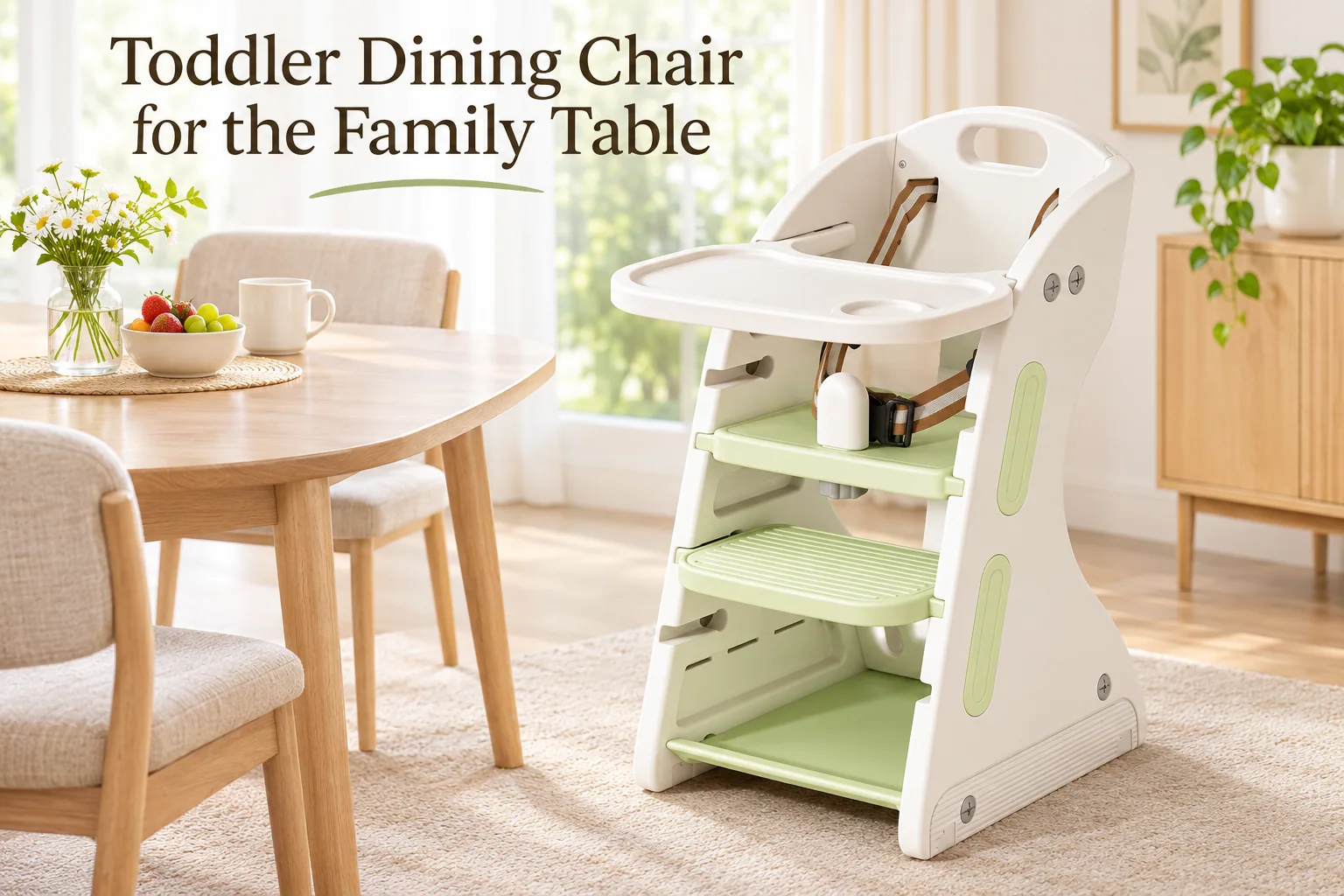
SUNORA CZY-002, shown with its included dining tray.
Measure Your Dining Table Before Choosing a Toddler Chair
First, check whether the instructions for the exact model and configuration allow your child to eat at the family table. If they do, measure the space at your child’s place setting and follow the manufacturer’s placement instructions. Take the first measurement from the floor to the top of the table. Then measure from the floor to the lowest point underneath at your child’s place. On a farmhouse table, that may be the apron, the vertical board running just below the edge. Two tables with identical tabletop heights can have quite different amounts of room underneath.
Measure the space between the table legs, too. Look down at the floor for a pedestal base, stretcher, or crossbar that might meet the chair feet before the seat reaches the table. Mark the chair’s listed footprint with painter’s tape. Can an adult sit beside it, pull out their own chair, and reach the child easily? Try the spot you’ll actually use on a crowded weeknight.
Ask for the distance from the floor to the top of the seat at each approved setting. Subtract that measurement from the tabletop height to compare how far the eating surface sits above the seat. For clearance, compare the underside of the apron with the height of any chair part that would pass beneath it. Neither comparison establishes a safe position by itself. Follow the manual on placement, including distance from surfaces a child could push against.
Look for an Adjustable Seat and Footrest
Seat height changes where the table meets your child. Footrest height changes where their feet land once the seat is set. Check both on the same configuration. Raising a seat to bring a bowl within reach can leave feet dangling if the footrest stays too far below it.
Look at the adjustment diagram before you buy. Does it show which seat and footrest positions can be used together? Can you tell when each part is fully secured? Make adjustments with the chair empty and follow the manufacturer’s instructions before seating your child again. A useful high chair footrest is one your child can reach in an approved setting and that you can check after moving it.
SUNORA’s white and pale green chair has an adjustable seat and footrest. Both models list overall dimensions of 58.0 × 46.0 × 84.0 cm. The 84.0 cm figure describes the chair’s overall height. Ask for the seat heights and footrest range before deciding whether either version will work at your table.
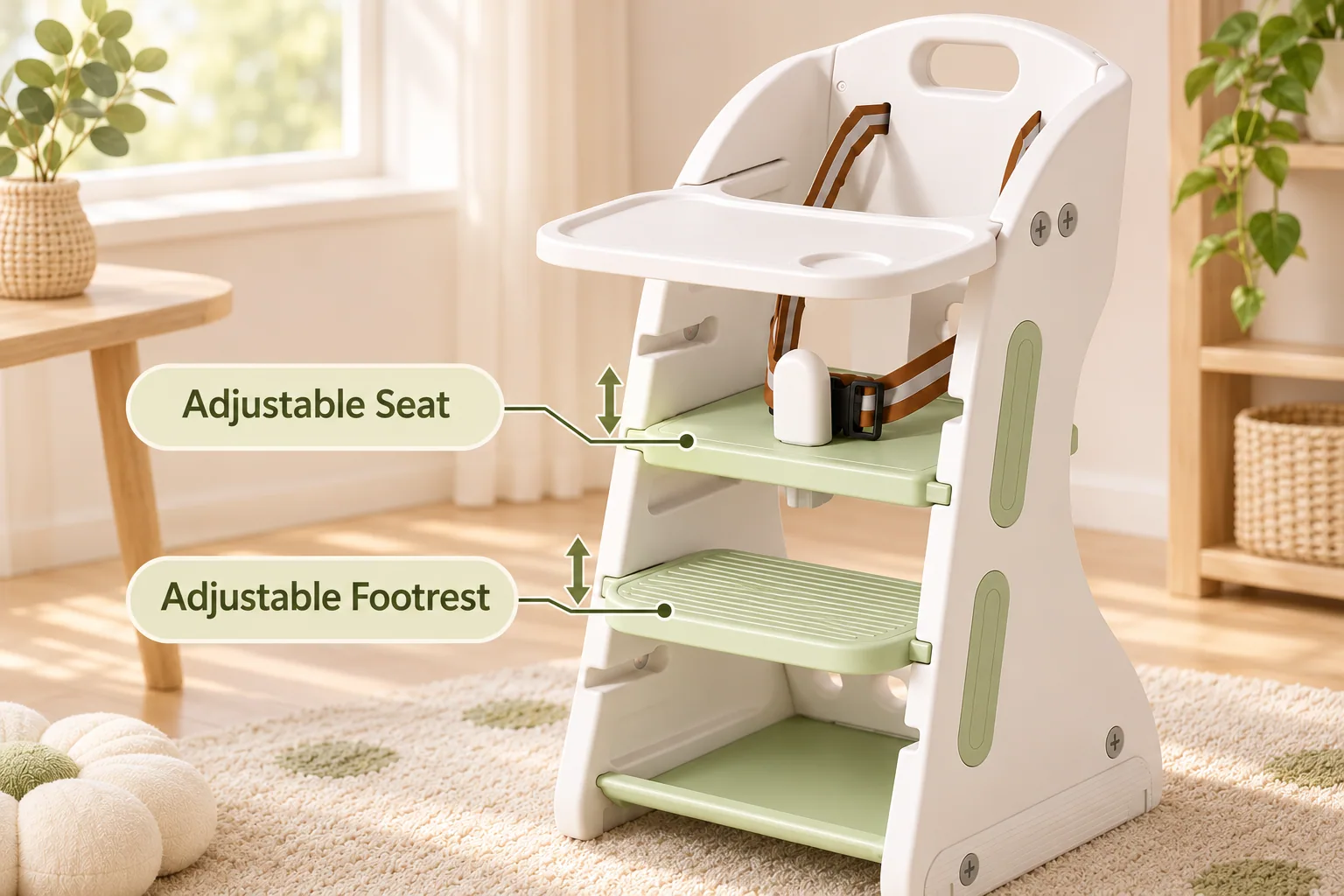
Compare the seat and footrest together when requesting measurements.
HDPE vs. Wood: Which Toddler Dining Chair Is Easier to Clean?
Think about the last spoonful of oatmeal that missed the bowl. You can usually wipe oatmeal from an open seat in one pass. Food pressed into a groove beside the seat can take more work. Look closely at those spots when shopping for an easy-to-clean high chair.
SUNORA uses blow molding to form the chair body from high-density polyethylene (HDPE). The dining tray is also made from HDPE. HDPE is a practical material for children’s furniture. Its smooth surface is generally convenient for everyday wipe-down cleaning. Actual cleaning convenience also depends on surface texture, joints, tray design and the manufacturer’s care instructions. For a better sense of the whole cleanup job, look at where the seat and footrest meet the frame. For background on the material, Mitsubishi Chemical Group describes easy cleaning and low moisture absorption for its own Sanalite HDPE grade. That data sheet describes a different product.
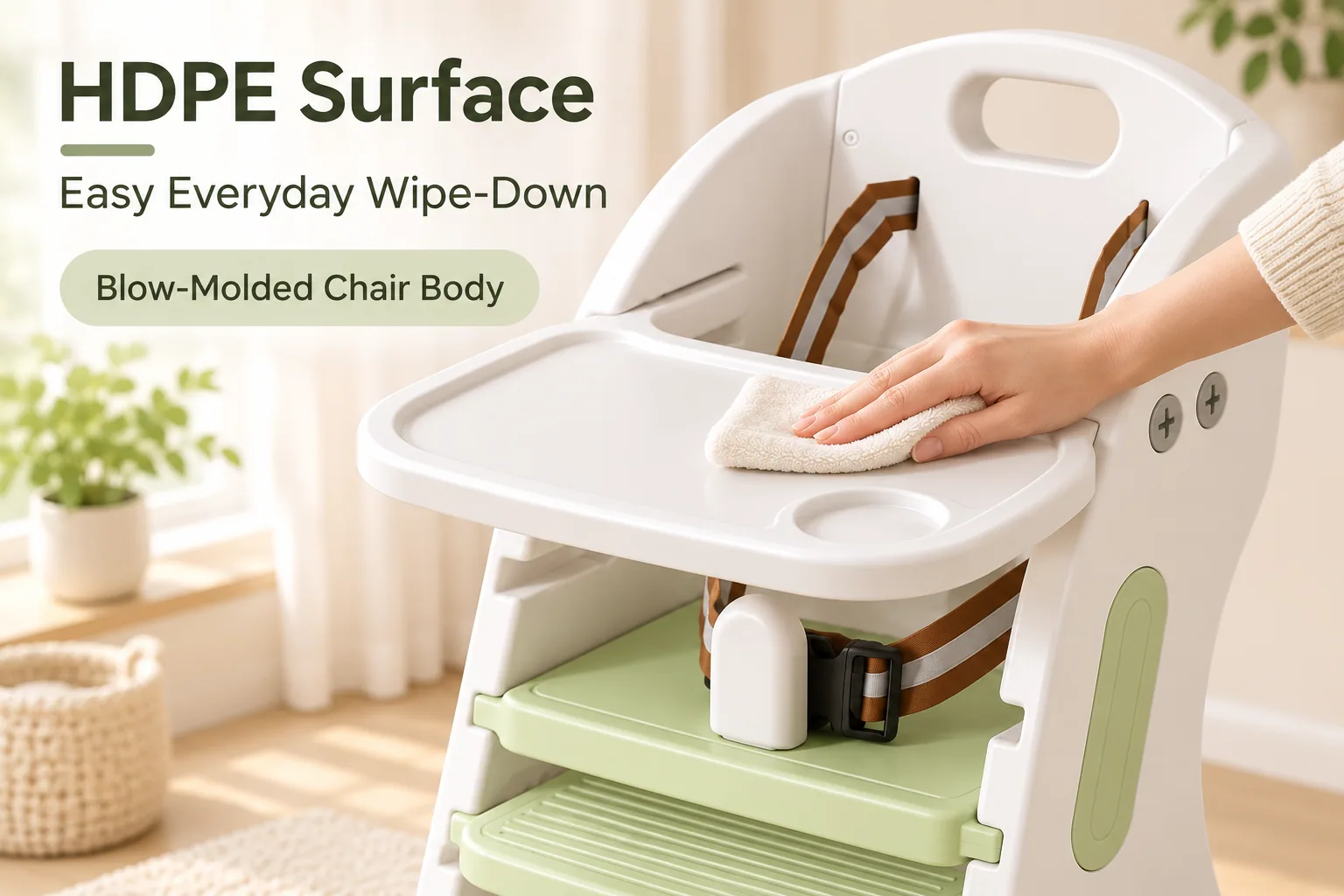
A wooden chair with an intact, suitably sealed finish can also wipe clean after a meal. Ask what finish is used and how the maker recommends caring for it. If a secondhand chair has worn patches along the tray edge, get care instructions specific to that finish. The American Cleaning Institute’s hard-surface guide distinguishes between surface types and finishes when discussing cleaning products.
| What to inspect | Blow-molded HDPE body | Finished wood |
|---|---|---|
| Broad surfaces | Check whether texture catches dried food as you wipe. | Check that the finish is intact where food and wet cloths touch it most. |
| Edges and joints | Look under molded lips and around the adjustment points. | Look along board joints, hardware, and the ends of seat grooves. |
| Care after spills | Check the manual for approved cleaners and care of attached parts. | Follow the finish-specific directions for moisture, cleaners, and drying. |
If you can see a display chair, trace the path of a spill from the eating surface to the footrest. Could you reach every spot with the corner of a cloth? If you’re shopping online, ask for a close-up of the underside of the tray and the seam behind the seat. A front-facing product photo rarely answers either question.
Check the Tray Configuration and Everyday Feeding Setup
Decide where the plate will go. If your child will eat from the family table, prioritize table clearance and the manufacturer’s placement instructions. If you want a separate eating surface, check exactly which model includes one. A gallery can show an accessory that only ships with one version.
| SUNORA model | What comes with it | Listed net weight |
|---|---|---|
| CZY-001 | Chair only | 4.75 kg |
| CZY-002 | Chair and dining tray | 5.4 kg |
For CZY-002, request the tray-use and cleaning instructions if your routine depends on taking it to the sink. Tray inclusion alone doesn’t tell you whether it can be removed or how it should be washed.
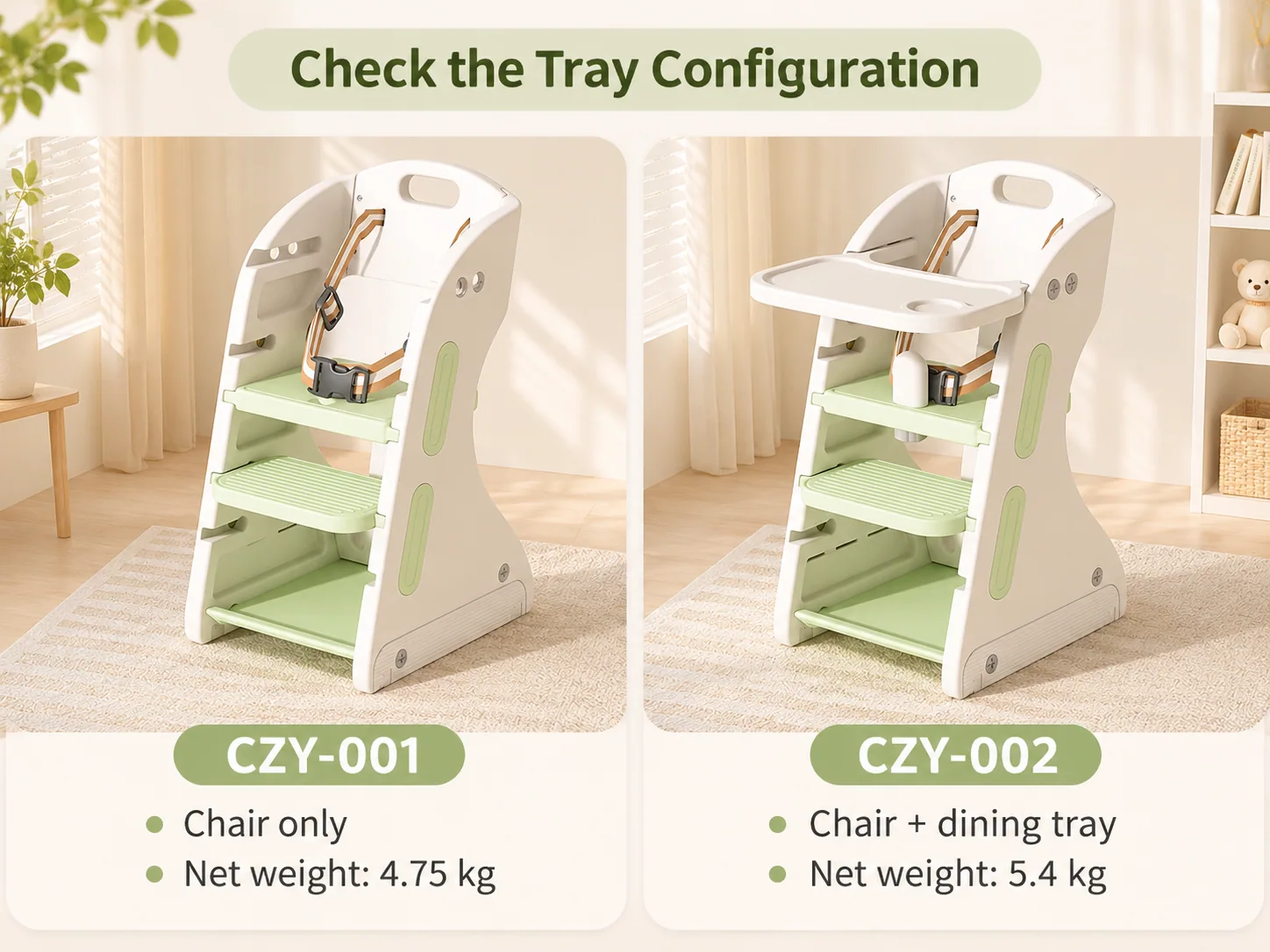
The dining tray comes with CZY-002. CZY-001 is supplied chair only.
Check Stability, Restraints and Safety Information
Read the exact model’s instructions before purchase. Check the intended users, weight limit, required restraint system, and permitted configurations. Confirm the restraint type and whether it is included with the exact model. Look for clear illustrations showing how to secure the child and check each lock. The CPSC High Chairs FAQ explains why stability, structural integrity, restraints, and tray engagement matter. For high chairs covered by the federal rule, CPSC’s business guidance explains 16 CFR Part 1231, the incorporated ASTM F404 standard, and Children’s Product Certificate requirements.
At home, use the chair on a level surface and check that it is stable. Secure the child with the specified restraints every time. A tray cannot take their place, even when it locks securely. Stay with your child. A chair’s dimensions alone do not determine whether it is safe to use beside a dining table. Always follow the manufacturer’s placement instructions. Do not position a high chair where a child can push against a table or counter and tip it over. See CPSC’s high chair safety advice and the American Academy of Pediatrics’ six safety tips.
Toddler Dining Chair Buying Checklist
- Measure the tabletop, the underside of the apron, and the space between the table legs.
- Compare the chair footprint and actual seat heights with your measurements.
- Check which footrest positions are permitted with your chosen seat setting.
- Confirm the model number, included tray or chair-only configuration, and cleaning instructions.
- Find the age and weight limits, restraint instructions, and locking checks in the model manual.
- Leave room for an adult to sit close enough to supervise the whole meal.
Frequently Asked Questions
How do I choose a toddler chair for my dining table?
Measure at your child’s place setting, including any rail beneath the tabletop. Ask the seller for seat heights and the height of parts that need to clear that rail. Check the manual for placement guidance before deciding on a fit.
Is HDPE easy to clean?
The HDPE chair body and dining tray can generally be wiped clean after everyday spills. How long cleanup takes also depends on texture, grooves, straps, and tray edges. Check the chair maker’s care instructions for each part.
Is a footrest important on a toddler dining chair?
A reachable footrest gives your child a place to rest their feet during meals. Compare its position with the seat setting you’ll use. A footrest pictured at its highest setting tells you little unless you also know the distance from the seat.
Is a chair with a tray better than a chair without one?
Choose according to where your child will eat. A tray supplies a separate eating surface. A chair-only configuration may suit a family table if the measurements and instructions support that arrangement. Both require the safety checks specified for the model.
What safety information should I check before buying a toddler chair?
Ask for the current instructions for the exact model, including its intended use, age and weight limits, restraints, and assembly checks. If the seller can’t identify which manual goes with the chair, resolve that question before buying.
Conclusion
Keep your table measurements beside you as you compare chairs. They’ll help you narrow the choice faster than overall height or a lifestyle photo. Once you have a likely fit, look closely at the footrest, the path of a spill, and the parts included with your model. You can compare both configurations on the SUNORA adjustable toddler dining chair page. Include your table measurements and preferred model when you request specifications from SUNORA.
Sources & Further Reading
- CPSC — High Chairs FAQ
- CPSC — High Chairs Business Guidance
- CPSC — Federal High Chair Standard and Safety Advice
- American Academy of Pediatrics — 6 Quick High Chair Safety Tips
- American Cleaning Institute — Cleaning Hard Surfaces
- Mitsubishi Chemical Group — Sanalite HDPE